Understand the Method
See the practical factors that control viscosity in oil-based and synthetic-based drilling fluid.
Technical How-To Page
Viscosity in oil-based and synthetic-based drilling fluid is controlled by selecting a matching organoclay grade, activating it correctly, and dosing it to the current TDS. This page walks through base-fluid confirmation, grade selection, mixing and activation, and reading plastic viscosity, yield point, and gel strength results. Request current TDS, samples, or a grade recommendation before running a mix test.

Quick Technical Answer
This page helps buyers and formulators quickly:
See the practical factors that control viscosity in oil-based and synthetic-based drilling fluid.
Move from base-fluid confirmation to grade selection, mixing, and testing.
Connect plastic viscosity, yield point, and gel strength readings to the organoclay role.
Check common causes before changing grade or dosage.
Request TDS, SDS/MSDS, COA and samples before internal approval and purchase.
Definition
Viscosity control means keeping a drilling fluid's flow resistance, yield point, and gel strength within the target window for the well design. In oil-based and synthetic-based systems, organoclay is the organophilic clay additive most commonly used to build this structure, because it disperses across the continuous oil phase and develops a controllable rheological network.
The response depends on the organoclay grade, base oil, mud weight, temperature, and mixing energy. Viscosity targets should be validated through rheology testing, and the final grade and loading confirmed against the current TDS before field use.
Step-By-Step Procedure
Follow these steps in order. Final loading and mixing parameters should always be confirmed against the current TDS for the selected grade.
Record the base oil or synthetic fluid, mud weight, temperature window, and target viscosity or rheology profile before selecting an additive.
Match an approved OD-series grade to the fluid system, for example an OBM viscosifier path for oil-based mud or a high-temperature path for HPHT wells, using the grade selection guide.
Confirm the polar activator, addition sequence, and shear energy needed so the organoclay develops structure fully during mixing.
Add the organoclay at the loading indicated by the current TDS, and disperse with sufficient shear and mixing time before taking initial readings.
Run standard oilfield mud testing to record plastic viscosity, yield point, and gel strength readings on a viscometer.
Compare readings with the target rheology window, adjust loading or mixing energy if needed, retest, and confirm the final formulation with the current TDS and technical support before field use.

How It Works
These performance areas help procurement and technical teams decide whether to request TDS, plan a mix test, or ask for a grade recommendation.
Choosing the OD-series grade that fits the base oil and system builds predictable structure.
Correct polar activator and addition sequence lets the organoclay disperse and build structure fully.
Loading within the current TDS range keeps viscosity in the intended working window.
Sufficient shear during mixing supports even dispersion and consistent readings.
Standard and high-temperature grade paths respond differently as downhole temperature rises.
Plastic viscosity, yield point, and gel strength together describe the viscosity profile.
Reading Results
Run standard oilfield rheology testing and compare readings with the target window for the well design before finalizing the formulation.
| Rheology parameter | Why it matters | Organoclay role |
|---|---|---|
| Plastic viscosity (PV) | Flow resistance from the fluid itself | Structure built across the continuous oil phase |
| Yield point (YP) | Cuttings transport and hole cleaning | Yield structure the organoclay contributes |
| Gel strength (10s / 10min) | Suspension when circulation stops | Static structure the organoclay develops |
| 6-RPM / 3-RPM readings | Low-shear behavior at low pump rates | Low-shear structure supported by organoclay |
Troubleshooting
Use this table to connect a common viscosity problem with the likely cause and the practical check to run before changing grade or dosage.
| Viscosity problem | Likely cause | Buyer check before changing |
|---|---|---|
| Viscosity too high after mixing | Excess shear, over-dosage, or grade mismatch with base oil | Review mixing energy and dosage against current TDS before adjusting |
| Viscosity too low after mixing | Insufficient shear, under-dosage, or incomplete activation | Check activation sequence and shear time before adding more product |
| Inconsistent readings between batches | Variable mixing energy or addition sequence | Standardize the mixing procedure and re-test under the same conditions |
| Viscosity drops at higher temperature | Standard grade used outside its temperature window | Review the high-temperature organoclay path and confirm with current TDS |
| Slow viscosity build during mixing | Grade not matched to base oil or insufficient activator | Confirm base oil compatibility and activation route before changing dosage |
Product Direction
Only approved OD-series grade paths are shown. Final selection should be confirmed with current TDS, sample testing, and technical review.
Primary oil-based mud viscosity-control path for OBM buyers.
View Product Severe-condition grade path for HPHT viscosity control review.
View Product General organophilic clay drilling-grade category for OBM and SBM.
View Product Compare approved OD-series grade paths before testing a formulation.
Compare Grades See the wider rheology-control role organoclay plays in the fluid system.
Open Solution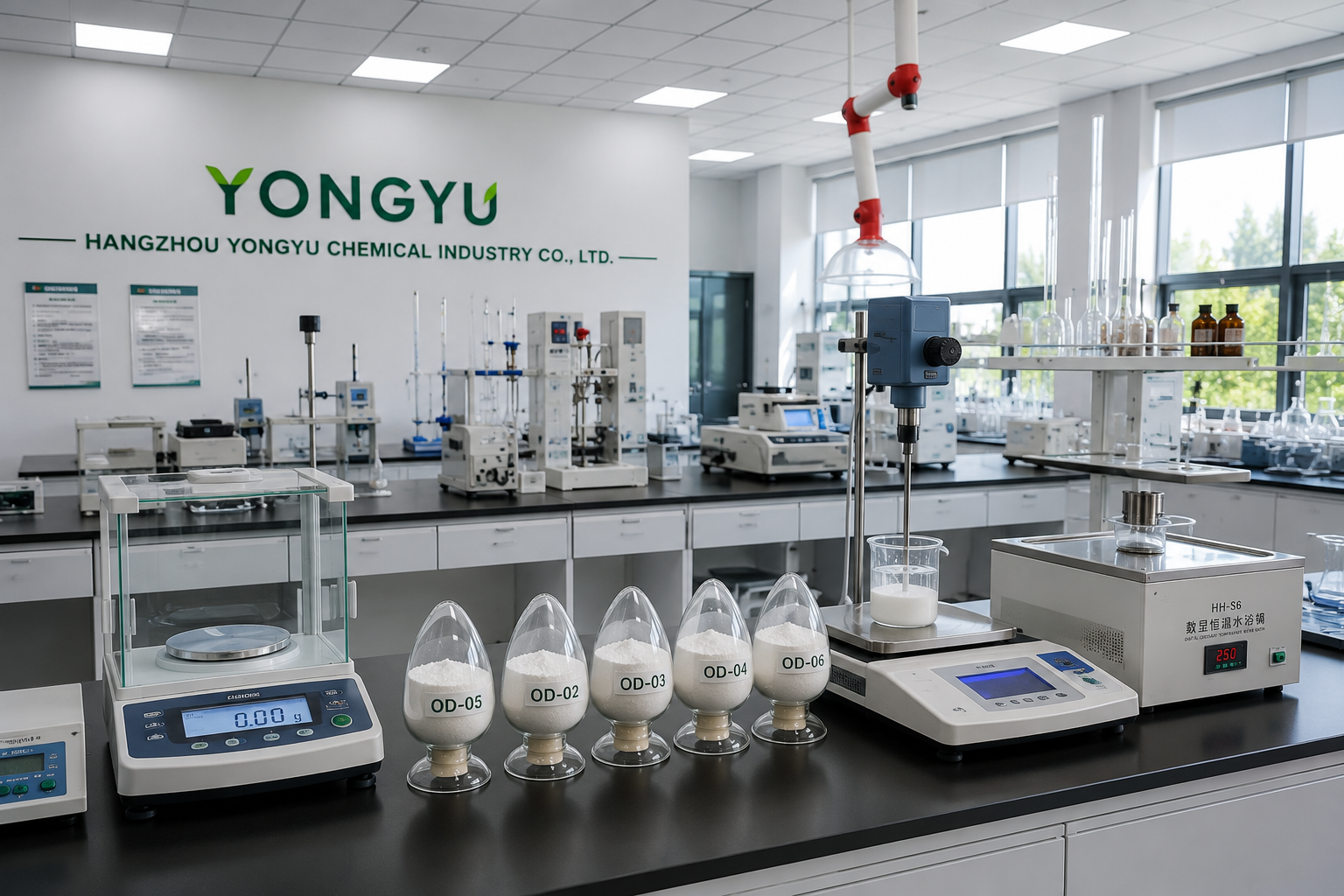
Manufacturer Direct Supply
HANGZHOU YONGYU CHEMICAL INDUSTRY CO., LTD. is presented in the approved project brief as a manufacturer established in 2005, with annual capacity of 25,000 tons per year. The team supports grade selection, export communication, document requests, sample evaluation, and quotation discussion for international oilfield chemical buyers.
Approved procurement facts include 25 kgs/bag packaging, MOQ of 1,000 kgs, and lead time of 7-10 working days after receiving deposit.
Technical Documents
Use these document paths to support viscosity review, safety review, procurement approval, and sample testing.
Review current technical information before viscosity testing, internal approval, or supplier comparison.
Download / Request SDS / MSDSSupport safety, handling, compliance, and procurement document review before ordering.
Download / Request COAAsk for COA support where available when sample or batch-level quality review is required.
Download / Request Sample RequestShare your fluid system, base oil, and viscosity target for evaluation guidance.
Request SampleBuyer Questions
Viscosity in oil-based and synthetic-based drilling fluid is mainly controlled by selecting the right organoclay (organophilic clay) grade, activating it correctly with a polar activator, and dosing it according to the current TDS. Mixing energy, base oil type, mud weight, and temperature all affect how much structure the organoclay develops. Buyers should confirm the fluid system and target rheology profile, then request a grade recommendation and TDS before running a mix test.
It depends on the fluid system, base oil, mud weight, and temperature. For general oil-based mud viscosity control, buyers often start with the OBM viscosifier path around OD-20 or a drilling-grade path such as OD-05; high-temperature wells point toward OD-29, and dispersion-sensitive systems may review OD-28 or OD-E29. Share your base oil, mud weight, temperature, and target viscosity so the technical team can route you to a suitable OD-series grade, then confirm with the current TDS.
Common causes include a grade that does not match the base oil, insufficient or excessive shear during mixing, an incorrect addition sequence, dosage outside the TDS range, or a temperature and contamination profile outside the design window. Before changing dosage, review the mixing procedure, activation conditions, and the rest of the formulation. If the viscosity issue continues, share your fluid details and rheology readings with the technical team so the review focuses on the actual variable.
Higher downhole temperatures can reduce the structure an organoclay grade holds in a drilling fluid, which is why standard and high-temperature grades are positioned differently. For elevated or HPHT wells, review the high-temperature organoclay path and confirm the operating temperature window against the current TDS before finalizing grade selection and loading.
Request the current TDS for technical and formulation review, the SDS/MSDS for safety, handling, and compliance review, and a COA where available when batch-level quality confirmation is required. Include your fluid system, base oil, mud weight, temperature, and target viscosity so the team can route the correct document and grade recommendation for your evaluation.
Yes. Samples are available for buyer evaluation when the request includes enough technical context. Share your fluid system, base oil, mud weight, temperature, target viscosity or rheology profile, expected quantity, destination country, and required documents. The team can then confirm whether to start with TDS review, a mix test sample, quotation support, or a grade recommendation.
Technical Contact
Discuss base oil, mud weight, temperature condition, and viscosity target before selecting a grade.
Support Email SupportUse the contact path to send documents, mix-test questions, and procurement requirements.
Support RFQ SupportRequest quotation details for quantity, packaging, lead time, and export communication.
Support Product RecommendationAsk the team to route your request toward the suitable OD-series grade path.
Bottom CTA
Send your fluid system, base oil, mud weight, temperature condition, target viscosity, quantity, and document requirements. The technical team can route you to the right OD-series grade path, TDS, sample, or quotation.